


DisplayPort is a widely spread audio/video interface standard designed by VESA (Video Electronics Standard Association) in 2006. The aim was to create an interface that would be the connection between graphic cards and display devices. The standard is available and free, thus it can be implemented widely, which could help replace the previously used interfaces, such as VGA or DVI.
Lightware’s DP-OPT extenders are designed according to DisplayPort standard 1.1a. The maximum allowed bandwidth is 10.8 Gbps, which means e.g. 2560x1600 pixel resolution at 60 Hz or 4096x2400 pixels at 30 Hz. Color depth is up to 16 bits per color and 8-channel embedded LPCM audio is supported.
The mentioned standard was designed to support HDMI/DVI display devices too. If the sink is assembled with DVI or HDMI input connector, it can be connected to a dual mode DisplayPort source by a passive adaptor (DP++). In this case the source switches to DVI/HDMI mode, and the signal is changed to be in line with DVI/HDMI requirements.
INFO:Most of the sources assembled with DisplayPort supports Dual mode, but if you are not sure, check the documentation of your device.
Passive adaptor
A display device with a HDMI or DVI connector can be connected by a passive DP-HDMI or DP-DVI adaptor to the source. The passive adaptor has two functions: sending a sign to the source if DVI or HDMI signal is required, and doing level shifting from +3.3V to +5V. The source switches to DVI/HDMI mode and sends the proper signal.
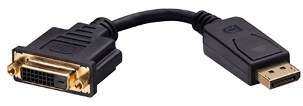
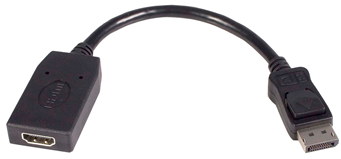
DP-DVI and DP-HDMI Passive Adaptors
INFO:More information about adaptors can be found in the VESA DisplayPort Interoperability Guideline (www.displayport.org).